Welcome to the Animal Cell Page!
On this page you will learn all about the different parts of the animal cell.
Animal cells are eukaryotes, so they contain a nucleus. The nucleus houses the DNA. The nucleolus, inside the nucleus, makes ribosomes. The ribosomes make proteins. The proteins are then transported through the rough and smooth endoplasmic reticulum until they reach the golgi apparatus. The golgi packages up the proteins and ships them off in vesicles to where they need to go.
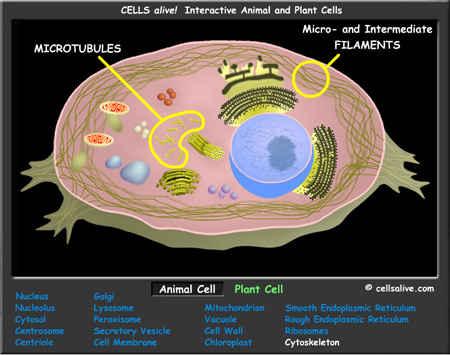
Please click on the picture above
to go
to CellsAlive
Animal cells are surrounded by a thin, flexible barrier called a cell membrane. This allows certain things to enter and leave the cell. The lysosomes contain digestive enzymes which act as a trash can for the cell and get rid of unnecessary waste.
The "Mighty" mitochondria provide the power and energy for the cell. Your muscle cells have many, many mitochondria.
The cytoplasm is the jelly-like substance that all of the organelles float around in.
Please visit CellsAlive or click on the image to the right for an animation of the animal cell.
View the video below for a review of Animal Cells.
Take the Animal Cell Quiz!
What type of cell is an animal cell?
A. Prokaryote
B. Eukaryote
What is the "powerhouse" of the cell?
A. Nucleus
B. Nucleolus
C. Cell membrane
D. Mitochondria
Which organelle is a thin, flexible barrier that surrounds the cell?
A. Cell wall
B. Cell membrane
C. Nuclear membrane
D. Lysosome
Which structure contains the DNA?
A. Endoplasmic reticulum
B. Golgi apparatus
C. Nucleus
D.
Ribosome
Which organelle makes proteins?
A. Nucleolus
B. Ribosome
C. Nucleus
D. Golgi Apparatus